


Looking for a nonprofit strategic plan example or template?
You're in the right place. Whether you're searching for a nonprofit strategic plan example or a template you can adapt, this is the largest collection of real plans on the internet. It includes our own starter template, and a repository of examples organized by sector so you can find one that matches your mission. This page also explains what the best plans include, and shows you how to create a strategic plan your board and staff can actually use.
If you want more than inspiration, we also show you how to build your own plan using the Nonprofit Strategic Planning Toolbox, including a guidebook to help you through planning, retreat tools, OKR dashboards, and Strately™, our AI-powered planning assistant.
Start Here: Nonprofit Strategic Plan Template
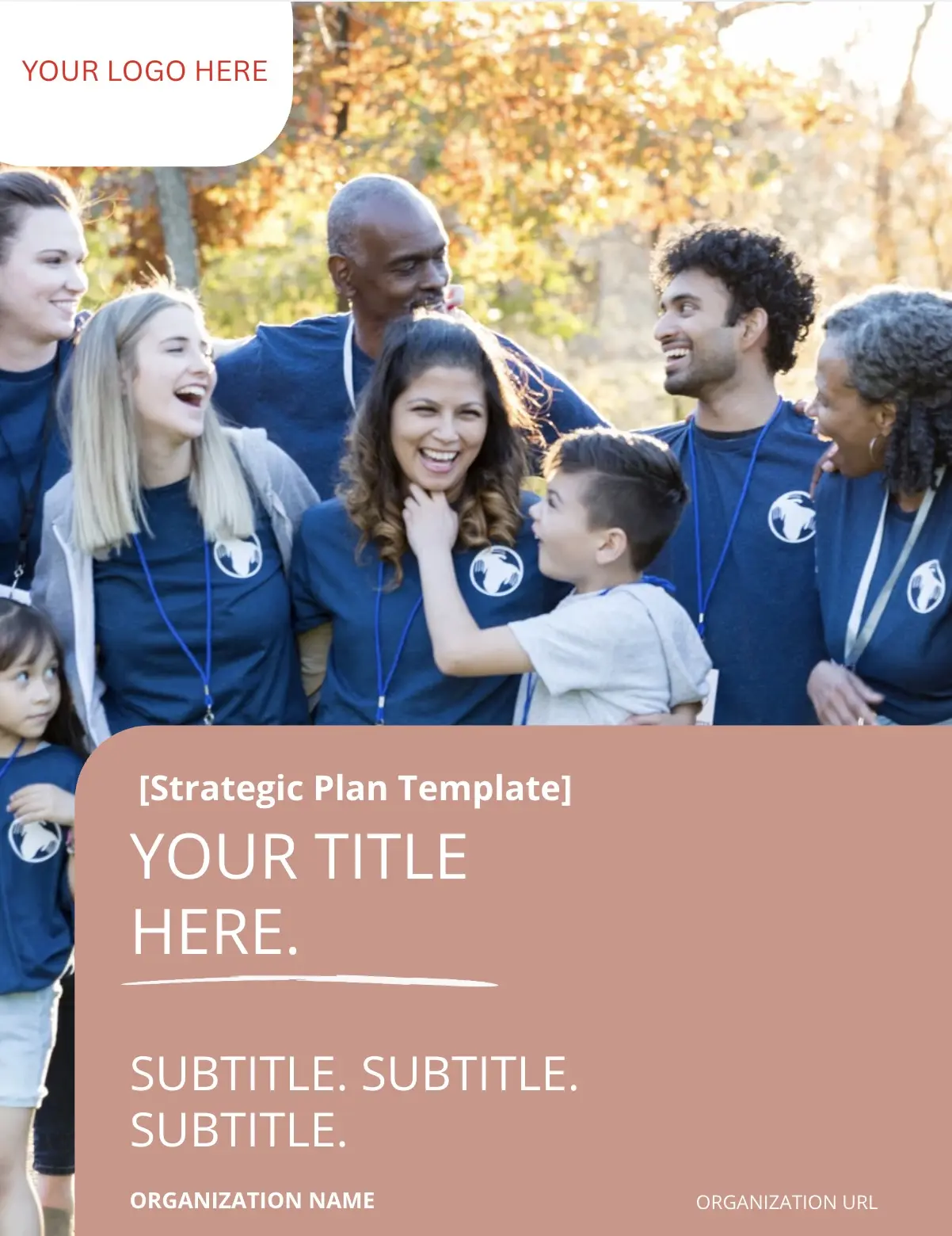
Download Prosper Strategies’ free nonprofit strategic plan template to start organizing your goals, priorities and action steps in a format your team can actually use.
- ✓Clarify the core elements of your strategic plan.
- ✓Turn big priorities into actionable next steps.
- ✓Create a stronger starting point for planning conversations.
Quick answer: what is a nonprofit strategic plan?
A nonprofit strategic plan is a document and decision-making framework that helps an organization define where it is going, what priorities matter most, and how it will measure progress over the next three to five years. Strong nonprofit strategic plans usually include a mission, vision, strategic priorities or pillars, measurable goals, accountability systems such as Objectives and Key Results (OKRs), and implementation systems. Learn more about what a nonprofit strategic plan is here
The best nonprofit strategic plans are not copied from another organization, nor are they built by board and staff leaders alone. They are built with input from partners, funders, staff, board members, and most importantly, the people and communities the nonprofit exists to serve. This is what we call Shared Power Strategic Planning™.
Table of Contents
Looking for more than examples?
Prosper Strategies offers four levels of nonprofit strategic planning support — from a $279 self-guided Toolbox to full-service consulting.
Find the right fit for your nonprofitWhat is nonprofit strategic planning?
Nonprofit strategic planning is the process of deciding how your organization will increase its impact over the next three to five years. It helps your leadership team and board move from a list of good ideas to a focused set of priorities, measurable outcomes, and practical systems for execution.
A strong strategic planning process does not stop at writing a polished PDF. It aligns your staff and board around the same direction, clarifies tradeoffs, and creates a structure for turning priorities into action.
Direction
Clarify mission, vision, values, and the future state your organization is working toward.
Pillars
Define a limited number of strategic focus areas that matter most right now, and will become your change agenda for the next 3-5 years.
Execution
Translate strategy into measurable OKRs, ownership, timelines, dashboards, and check-ins.
What good nonprofit strategic plan examples show
When CEOs, executive directors and board leaders search for a nonprofit strategic plan example, they are usually trying to answer one of four questions:
| Question | What to look for in examples | What you still need for your own plan |
|---|---|---|
| What does a finished plan look like? | Structure, layout, section order, level of detail, design style | A template and process that fits your team |
| What should be included? | Mission, vision, values, pillars, goals, OKRs, implementation approach | Research, stakeholder input, and decision tools |
| How detailed should it be? | Different versions for public audiences and internal teams | Internal tools for ownership, timelines, and accountability |
| How do we make ours actually usable? | Examples with clear priorities and measurable outcomes | OKR frameworks, dashboards, retreat tools, and rollout materials |
The best strategic plan examples give you context and inspiration. The best planning systems give you momentum and execution.
Want to skip the blank-page problem and DIY your own plan?
The Nonprofit Strategic Planning Toolbox gives you a proven Shared Power Strategy™ process, practical templates, OKR tools, and Strately™ so you can move from “we need a plan” to “we have a real planning system” much faster, at a fraction of the cost of traditional strategic planning consulting engagements. The Toolbox:
- Is built for executive directors and nonprofit leadership teams
- Includes retreat tools, research templates, and final plan formats
- Helps you build measurable OKRs and OKR dashboards so the plan is measurable and does not die on the shelf
- PRO includes Strately™, your AI-powered planning assistant
How to Use These Examples as Templates
- Pick the closest sector match. A youth-serving plan reads differently from a faith-based or arts plan. Start with the closest example to skip the work of translating context.
- Borrow the structure, not the words. Look at how the plan is organized — mission/vision first or priorities first? Three pillars or seven? — and use that skeleton as your template.
- Replace, don't paraphrase. The template is the bones. The meat has to be yours. Plans fail when they sound like someone else's with the names changed.
- Or skip the work entirely. The Nonprofit Strategic Planning Toolbox is the fillable version of every example below — every prompt, framework, and section header set up for you. It's what we'd hand a client to do this themselves.
50+ nonprofit strategic plan examples and templates
Below are 50+ public nonprofit strategic plan examples across issue areas. Use them to study structure, voice, and design. As you review them, notice how organizations present their priorities, whether they publish high-level plans or detailed frameworks, and how clearly they connect strategy to accountability.
Note: Public links can change over time. It is smart to review examples for structure and approach, not to copy content directly.
Animal Welfare and Environment
Community Development and Social Justice
Hunger Nonprofits
Arts & Culture Nonprofits
Health Nonprofits
Youth-Serving and Education Nonprofits
International Aid Nonprofits
Human Services Nonprofits
Faith-Based Nonprofits
Associations
Think you can't afford an effective strategic plan? Think again.
For many nonprofits, the hardest part is not understanding what a strategic plan is. It is knowing how to run the process, how to gather the right input, and how to turn the plan into action. That is why we created the Nonprofit Strategic Planning Toolbox. It includes tools such as:
- Stakeholder engagement roadmap
- Survey and interview templates
- Retreat agenda and workshop slides
- Final strategic plan templates
- OKR workshop materials and dashboard
- Quarterly planning tools
- Shared Power Strategy™ framework
- PRO access to Strately™ AI support
How to approach nonprofit strategic planning: 7 best practices
Examples can show you what a finished plan looks like. Best practices show you how to build one that your board and staff will actually use. Keep these seven principles in mind when developing your own nonprofit strategic plan.
At a glance: 7 nonprofit strategic planning best practices
As you build your plan, keep these seven practices in view: involve stakeholders throughout the process, conduct research, ground the work in mission and vision, ask strategic questions, challenge the status quo, use measurable OKRs, and plan for accountability from day one.
1. Involve stakeholders throughout the process
Strong strategic plans are not built in isolation. They incorporate input from staff, board members, program participants, donors, partners, and community stakeholders at multiple checkpoints—not just the beginning. This is the foundation of our Shared Power Strategy™ approach.
A practical way to start is with a planning committee made up of key staff leaders, a smaller board planning group, and a stakeholder group representing people your mission exists to serve.
2. Conduct research before you set priorities
The best plans are grounded in real evidence, not assumptions. Use surveys, interviews, internal documents, ecosystem research, and comparator organizations to understand your current reality before you decide what comes next.
This work surfaces strengths, risks, opportunities, and patterns that should shape your pillars and Objectives and Key Results.
3. Ground the work in mission and vision
Your mission explains the work you do now. Your vision describes the future you are trying to create. Strategic planning should test whether both still hold true and then use them as filters for every major decision.
When teams skip this step, plans tend to become a disconnected wish list instead of a strategy.
4. Ask strategic questions
Good planning creates space for leaders to wrestle with tradeoffs. Should you grow geographically? Diversify revenue? Shift programming? Invest in brand visibility? Strategic questions help your team move from vague ambition to focused decision-making.
Once you identify the right questions, group them into themes that can become strategic pillars.
5. Challenge the status quo
A strategic plan should not simply document what you are already doing. It should force you to clarify what needs to change, what deserves more investment, and what should stop.
That often means creating a small number of bold, thematic pillars that define your real change agenda for the next three to five years.
6. Use measurable OKRs
This is where plans become actionable. For each pillar, define a small set of objectives and measurable key results so staff and board members know what success looks like.
OKRs matter because they make strategy visible, trackable, and easier to manage quarter by quarter.
7. Build accountability into the plan from day one
Implementation should not be an afterthought. Before your plan is finalized, you should already know who owns each pillar or objective, how progress will be reviewed, and what dashboards, meeting rhythms, or quarterly planning tools will keep the plan alive.
That is one reason so many nonprofits struggle after the retreat: they publish a strategy without building the operating system needed to carry it out.
What these best practices look like in real life
- Build a primary planning committee. This group usually includes your executive director or CEO and senior leaders across operations, finance, fundraising, marketing, and programs.
- Use a smaller board strategic planning committee. A focused group can provide input at key checkpoints before materials go to the full board.
- Map stakeholder roles intentionally. Decide where clients, community members, donors, funders, and partners will be informed, consulted, or asked to shape decisions.
- Translate strategic questions into pillars. Themes such as operational excellence, family programming, brand visibility, or growth can become the high-level priorities that organize the plan.
What keeps a plan from becoming shelfware
- Use research summaries to align the team. Pull together the biggest “a-ha” insights from interviews, surveys, and internal documents before you start prioritizing.
- Set measurable objectives and key results for each pillar. A plan is stronger when each pillar has clear outcomes and evidence of success.
- Assign ownership and review cycles. Define who owns what and how progress will be checked quarterly.
- Give the team a real process, not just a PDF. Templates, retreat materials, OKR dashboards, and progress meetings make implementation much more likely.
Need the template and process behind the best practices?
Examples show you what good plans look like. The Nonprofit Strategic Planning Toolbox gives you the actual templates, processes and facilitation tools for doing the work in-house—from research and stakeholder engagement to pillars, OKRs, and implementation.
How to create your own plan with the Nonprofit Strategic Planning Toolbox

Examples are useful, but they are still examples. If you want to create a nonprofit strategic plan without guessing your way through the process, the Nonprofit Strategic Planning Toolbox is designed to help you do exactly that.
The Toolbox is built around our Shared Power Strategy™ process and gives nonprofit leaders a practical system for planning in-house, at a fraction of the cost of traditional consulting. Instead of pulling bits and pieces from random blog posts and resources, you get an end-to-end planning pathway.
What’s inside
- Strategic Planning Guidebook
- Leadership kickoff tools
- Stakeholder engagement roadmap
- Survey templates and interview guides
- Retreat agenda and slide deck
- OKR workshop slides and dashboard
- Internal and external strategic plan templates
- Quarterly implementation tools
Why it converts plans into action
- It gives executive directors a planning process, not just a document.
- It helps teams move from stakeholder input to priorities to execution.
- It bakes in OKRs and accountability early.
- It reduces consulting dependency and blank-page overwhelm.
- PRO includes Strately™, an AI planning assistant trained on our methods.
Why OKRs matter
Most strategic plans sound fine at the board retreat and then fade in implementation. OKRs help prevent that. They make priorities measurable, create shared definitions of success, and give leadership teams a way to track progress quarter by quarter. That is why OKRs are a core part of our process and a major feature of the Toolbox.
Ready to plan faster and smarter? Meet Strately™ AI.
As a nonprofit leader, you do not need more theory. You need faster answers, sharper planning prompts, and help using the tools well. Strately™ gives PRO users AI-powered strategic planning support that is grounded in our Shared Power Strategy™ philosophy so their team can move faster without losing rigor. Strately™ is included in the PRO version of the Toolbox.
Core
Includes the essential planning tools needed to lead your strategic planning process in-house.
- Guidebook and core templates
- Research and retreat support
- OKR workshop materials
PRO
Includes everything in Core plus extra done-for-you tools, design assets, and Strately™.
- Additional templates and planning assets
- Canva strategic plan design files
- AI support with Strately™
Ready to build your own nonprofit strategic plan?
You can keep collecting examples, or you can use a proven planning system built specifically for nonprofits. The Nonprofit Strategic Planning Toolbox gives you templates, facilitation tools, research materials, OKR frameworks, and AI-powered support so your organization can create a strategic plan that is both thoughtful and usable.
Frequently asked questions about nonprofit strategic plan examples
What should a nonprofit strategic plan include?
A strong nonprofit strategic plan usually includes a mission, vision, a summary of key findings from research and stakeholder input, strategic priorities or pillars, measurable objectives, timelines, ownership, and a plan for implementation.
How long should a nonprofit strategic plan be?
Most nonprofits use a three-to-five-year strategic plan. Public-facing plans are often shorter and more polished, while internal planning documents include more detail on OKRs, dashboards, and accountability.
What's the difference between a strategic plan example and a strategic plan template?
Answer: in practice they're nearly the same; an example shows you a finished plan, a template gives you a structure to fill in; the 50+ plans here function as both; the Toolbox is the fillable version.
What is the nonprofit strategic planning process?
Answer: The strategic planning process we recommend has eight steps: prepare, plan for stakeholder engagement, research, host your retreat, build your OKRs, listen to your stakeholders, develop your final plan, and roll out/implement.
Can I use another organization’s strategic plan as a template?
You can use another nonprofit’s strategic plan as a reference for structure, but not as a substitute for your own planning. Your priorities should come from your mission, stakeholders, data, and leadership choices.
What is the difference between a strategic plan and a strategic planning process?
The strategic plan is the output. The strategic planning process is how you get there. The process includes research, stakeholder engagement, decision-making, facilitation, prioritization, and implementation planning.
What if we want to do strategic planning in-house?
That is exactly what the Nonprofit Strategic Planning Toolbox is built for. It gives you a proven pathway, templates, facilitation resources, and implementation tools so your team can lead the work without starting from scratch.
Why do OKRs matter in nonprofit strategic planning?
OKRs help turn strategy into measurable action. They make priorities clearer, help teams define success, and create a practical way to track progress across departments and quarters.
Ready to build your nonprofit's strategic plan?
Whether you want to do it yourself, attend a workshop, partner with us as facilitators, or have us handle the whole process, we have a pathway for you.
Learn more about our strategic planning options.

